Organizations are moving fast from Microsoft 365 Copilot pilots to role-based AI agents — what we call AI coworkers. The technology is ready before the operating model is. This FAQ answers the questions we hear most from leaders trying to scale AI responsibly: who decides, who oversees, how data stays protected, and how value gets measured.

Good governance lets AI coworkers earn more responsibility. Start agents with bounded roles. Expand their access and autonomy as evidence grows — so control becomes the path to speed, not the barrier.
What is agentic AI governance?
Agentic AI governance is the set of decision rights, controls, and feedback loops that determine what AI agents are allowed to do, what data they can touch, when a human must approve, and how their behavior is evaluated over time. Traditional IT governance asks “is this system secure and compliant?” Agentic governance adds a harder question: “is this agent’s behavior acceptable as its autonomy grows?” Our point of view: good governance lets AI coworkers earn more responsibility. Start agents with bounded roles, then expand their access and autonomy as evidence grows — so control becomes the path to speed, not the barrier.
How is agentic AI governance different from cloud governance?
Cloud governance controls resources: subscriptions, identities, cost, configuration. Agentic AI governance controls delegation: which decisions an organization is willing to hand to software, under what conditions, with what oversight. The two connect — agents run on cloud foundations, and FinOps discipline matters as agent usage scales — but the new muscle is behavioral: defining an agent’s job, its permissions, its escalation paths, and the evidence required before it takes on more.
What do you mean by “AI coworker”?
An AI coworker is an AI capability with a real job: a defined role, business owner, knowledge boundaries, permissions, handoffs to humans, and measures of success. Microsoft 365 Copilot assisting with drafting is a tool. A role-based agent that triages service requests, drafts responses within policy, and escalates edge cases to a named human — that is a coworker. The shift from tool to coworker is what makes governance unavoidable: coworkers act, and actions need accountability.
Where should we start: Copilot readiness or agents?
Start with Copilot readiness, because it surfaces every governance gap agents will inherit: overshared data, unclear ownership, missing usage metrics. A practical sequence is align (choose the workflows where Copilot or an agent can make a meaningful difference), design (define the coworker’s job, knowledge, permissions, and handoffs), prove (validate in real work, capturing evidence on value, risk, usability, and cost), and scale (turn validated patterns into repeatable services and standards). Skipping readiness does not save time — it moves the rework later, when agents are already touching production data.
Who should own AI coworkers in the organization?
Every AI coworker needs a named business owner accountable for its outcomes — not just an IT sponsor. We recommend a simple ownership model: a business owner who defines the job and accepts the risk, a platform team that provides the guardrails and observability, and governance functions (security, privacy, compliance) that set the non-negotiable boundaries. Without a business owner, agents become orphaned automation that nobody evaluates and everybody blames.
How do we control what data Copilot and agents can access?
Copilot respects existing Microsoft 365 permissions — which is exactly the problem when permissions are messy. Most organizations discover oversharing during their first Copilot pilot: sites and files accessible far beyond their intended audience. The fix is unglamorous and essential: inventory sensitive data, remediate broad sharing links, apply sensitivity labels, and use Microsoft Purview to monitor and enforce. For agents, go further — scope each agent’s knowledge sources explicitly rather than inheriting a user’s entire access. Least privilege applies to coworkers too.
What does human oversight of AI agents actually look like?
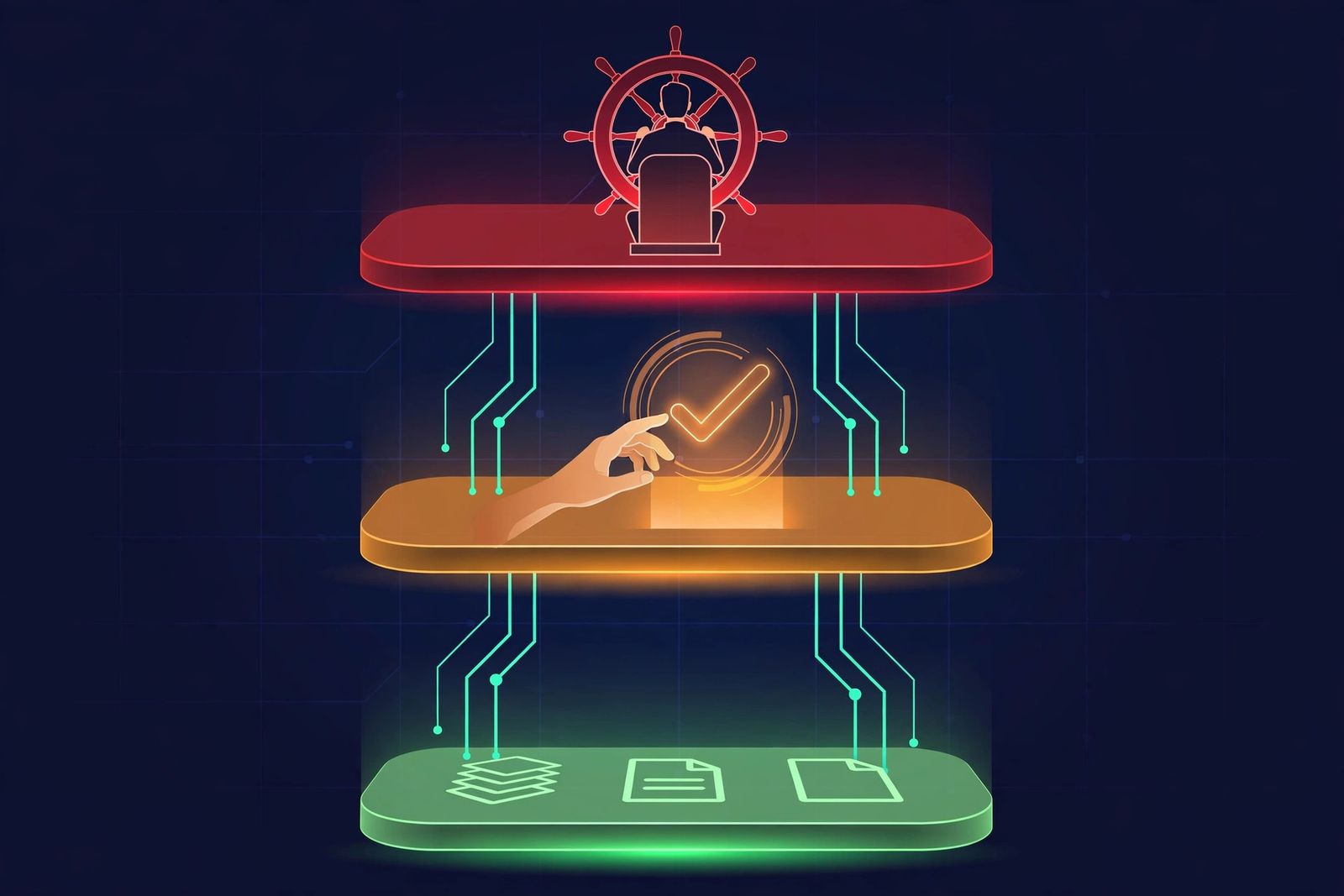
Oversight should be proportional to consequence. Low-risk actions (drafting, summarizing, retrieving) can run with logging and spot checks. Medium-risk actions (sending customer communications, updating records) need human approval workflows. High-risk actions (financial transactions, HR decisions, external commitments) need a human in the loop by design, not by policy document. Define these tiers before deployment, instrument the agent so every action is attributable, and review the approval queue as a first-class operational metric — a growing backlog of approvals is a signal the agent’s scope or the process needs redesign.
How do we measure the value of Copilot and AI coworkers?
Measure the work, not the tool. License activation and prompt counts tell you about adoption; they say nothing about value. For each AI coworker, define outcome metrics tied to its job before it launches: cycle time reduced, cases resolved without escalation, error rates, cost per transaction. Pair these with control metrics: approval rates, override rates, incident counts. Organizations that skip this step end up renewing Copilot licenses on faith. The ones that define value up front can expand with evidence — which is also what unlocks the next round of funding.
What are the biggest risks of agentic AI in the enterprise?
Four dominate: data exposure (agents surfacing sensitive content through inherited permissions), unreviewed action (agents taking consequential steps without meaningful human checkpoints), prompt injection and manipulation (malicious content in emails or documents steering agent behavior), and shadow AI (teams deploying their own agents outside any governance). Each has a known mitigation — permission hygiene, tiered approvals, input validation and sandboxing, and a sanctioned path for agent creation that is easier than going rogue. The risk is not the technology; it is deploying autonomy faster than accountability.
How do we deal with shadow AI?
Shadow AI is a signal, not just a violation: it means demand for AI capability is outrunning the sanctioned supply. The response that works is twofold — make the governed path the easy path (self-service agent templates with guardrails built in, fast intake, visible backlog), and make the boundaries explicit (which data classes and use cases require review, what happens on violation). Blocking alone drives usage further underground. Governed enablement brings it into the light where it can be measured and improved.
What role does Microsoft Purview play in AI governance?
Purview is the enforcement layer for data-centric AI governance in the Microsoft ecosystem: data discovery and classification, sensitivity labels, data loss prevention policies that extend to Copilot interactions, insider risk signals, and audit trails. It does not replace the operating model — someone still has to decide the policies Purview enforces — but it turns governance decisions into technical controls rather than aspirations. If your Purview posture is immature, your Copilot rollout will expose it.
How do we scale from a Copilot pilot to production AI coworkers?
Scale what is proven, not what is piloted. The pattern we see work: run Copilot with a defined cohort and clear success criteria; fix the data and permission issues the pilot reveals; introduce one or two role-based agents with bounded scope and named owners; validate value, risk, usability, and cost with real evidence; then industrialize — templates, standards, champion networks, and adoption motions that let the next team move faster. Each cycle should be cheaper and faster than the last. If it is not, the operating model — not the technology — is the bottleneck.
Microsoft resources on Copilot and AI governance
These Microsoft Learn and Microsoft sources back the practices above — worth bookmarking:
- Data protection in Microsoft 365 Copilot — how Copilot respects permissions, sensitivity labels, and DLP (Microsoft Learn)
- Enterprise data protection in Microsoft 365 Copilot — Microsoft’s commitments on prompts, responses, and model training (Microsoft Learn)
- Microsoft Purview DLP for Microsoft 365 Copilot — blocking sensitive prompts and files in Copilot interactions (Microsoft Learn)
- How Microsoft Purview secures AI data — applying labels, DLP, and insider risk to AI interactions (Microsoft Learn)
- How Microsoft 365 Copilot works — grounding, Microsoft Graph, and the permission model (Microsoft Learn)
- Security and governance for agents in Microsoft 365 Copilot — data protection and governance at scale for Copilot Studio agents (Microsoft Power Platform Blog)
Where should Copilot become a coworker — not just another tool?
Bring the workflow. Our team helps define the role, the controls, and the next practical move — from Copilot readiness through governed AI coworkers.